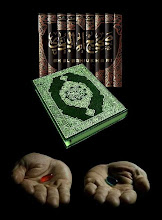
"This [Qur'an] is sent down from the Lord of all the worlds. If [the Prophet] had said anything against Us, We would certainly have seized his right hand and cut off his artery, and none of you could have defended him." (Qur'an 69:43-47)
"Surely the ‘HUKM’ (Law and Rule) is for none but Allah." (12:40)
"He does not make any one His associate in His ‘HUKM’ (Laws and Ruling)." (18:26)
The phrase "He (Allah) does not associate anyone in His Laws." (18:26)
Makes it quite clear that obedience and rule is only for the Law of Allah and no other law. Even a messenger of Allah does not have the authority to make anyone subservient to his personal commands, but obedience and subservience is only for the law of Allah, as the following verse declares:
"It is not meet for a Human Being that Allah should give him the Book and Government and 'Nabuwah' (Direct reception of Divine Messages), then he should say to people: Be subservient to me rather than Allah; but on the contrary (he would say): Become sustenance providers (to mankind) because of your teaching the Book and your studying (it yourselves)." (3:79)
The above verse declares that even a ‘Nabi’, i.e. a person who is a direct recipient of Allah’s message cannot make any other human being subservient to his own laws, but he too is asking the people to be obedient to the law of Allah by studying the Book of Allah and teaching it to others as well.
Allah commands the messenger:
"We know best what they say, and you are not one to compel them; therefore remind him by means of the Quran who fears My Promise." (50:45)
Thus Allah commands the messenger to admonish people by the Qur’an alone there is no 'Hadith' or 'Sunnah' in this verse and the messenger confirms himself that his mission is
"Admonishing with the Qur’an", not any other book:
"Allah is witness between you and me; and this Quran has been revealed to me that with it I may warn you and whomsoever it reaches." (6:19)
Again:
"O People of the Book! Indeed Our Messenger has come to you making clear to you much of what you concealed of the Book and passing over much; indeed, there has come to you light and a clear Book from Allah; With it Allah guides him who will follow His pleasure into the ways of safety and brings them out of utter darkness into light by His will and guides them to the right path." (5:15-16)
According to above verse the messenger is propagating the Book of Allahamong the people of the Book. Again we are reminded as to what the messenger is giving to his people as a teaching so that they receive divine guidance:
"I am commanded only that I should serve the Sustainer of this city, Who has made it sacred, and His are all things; and I am commanded that I should be of those who submit; And that I should recite the Quran. Therefore whoever goes aright, he goes aright for his own soul, and whoever goes ' astray, then say: I am only one of the warners." (27:91-22)
The messenger is to recite the Qur’an, so that whoever wishes, he can take guidance, says the above verse. Again it is emphasized that it is only the Qur’an whose propagation has been made as an obligation on the messenger:
"Most surely He Who has made the Quran binding on you will bring you back to the destination. Say: My Sustainer knows best him who has brought the guidance and him who is in manifest error." (28:85)
The above verse identifies that it is the Qur’an which is (an obligation) on the messenger. The above evidence from the Qur’an makes it quite clear that the messenger received the Book of Allah as divine teaching and he is delivering the message of Allah as is contained in Qur’an to the people. The above verses also make it evident that the messenger cannot deviate the slightest bit from the Qur’an and all his judgements are based entirely on Allah’s divine Book., as said in 5:48.
The messenger does not propagate his own personal laws or teachings like the mystery 'Hadith' and 'Sunnah' found outside of the Qur'an but only the divine message received by him, and that divine message has been identified in the above verses as Allah’s Book.
Obedience and subservience is only to Allah’s laws, not to 'Hadith' and 'Sunnah' outside of the Qur'an and the messenger does not make people obey his own teaching, but the law of Allah contained in al-Qur’an.
Obedience to the messenger means obedience to the message of Allah,as the messenger is delivering the message of Allah to mankind and no other laws.
It is only the law of Allah that people are asked to follow and be obedient to, saysthe Qur’an.
The rule of Allah is ordained all over the universe in the form of natural laws, but in human affairs, it is established by governing all matters of human life though the injunctions contained in Allah’s Book.
Muhammad is himself made to confirm that it is by introducing the injunctions of Allah’s distinctly elucidated Book, that Allah’s government is to be established in human affairs:
"Shall I then seek a Ruler other than Allah? When He it is Who has revealed to you the Book (which is) distinctly elucidated;" (6:114)
It is clearly established in the above verse that the messenger of Allah is also to put into practice the laws contained in the Book of Allah, and this clearly makes it evident that obedience to the messenger means obedience to the laws contained in Allah’s Book which the messenger is to establish in human affairs.
The messenger of Allah delivers only the message of Allah, and does not ask people to be obedient to any other rule or law other than that given in the Book of Allah. The following verses confirm that obedience to the messenger means obedience to the message being delivered by him:
"And obey Allah and obey the messenger and be cautious; but if you turn back, then know that only a clear deliverance of the message is (incumbent) on Our messenger." (5:92)
"And Allah has made for you of what He has created shelters, and He has given you in the mountains places of retreat, and He has given you garments to preserve you from the heat and coats of mail to preserve you in your fighting; even thus does He complete His favor upon you, that haply you may submit. But if they turn back, then on you devolves only the clear deliverance (of the message)." (16:81-82)
"And if you (o people) reject (the truth), nations before you did indeed reject (the truth); and nothing is incumbent on the messenger but a plain delivering (of the message)." (29:18)
"And obey Allah and obey the messenger, but if you turn back, then upon Our messenger devolves only the clear delivery (of the message)." (64:12)
"Say: Obey Allah and obey the messenger; but if you turn back, then on him rests that which is imposed on him and on you rests that which is imposed on you; and if you obey him, you are on the right way; and nothing rests on the messenger but clear delivering (of the message)." (24:54)
Could the Prophet Muhammad say that he was given something else other than the Qur'an when Allah tells Muhammad that had he said anything against Allah, Allah would certainly have seized his right hand and cut off his artery, and none of us could have defended him.
Allah clearly CHALLENGES the disbelievers to 'produce' a Hadith like the Qur'an itself:
"Let them then produce a "hadith" like this (Quran), if indeed they speak the truth". (Sura 52:34).
Here Allah says clearly that the Quran is the very best "hadith". Being the very best "hadith", the Quran therefore becomes THE GUIDANCE OF Allah. This immediately means that all other "hadith" are riot at all among the best hadith.
All other hadith simply cannot "SHOW HIM THE WAY".
Allah continues to tell us about "hadith".
He says,
"Allah, there is no other god, hut He. He will gather you together on the Day of Resurrection which is certain to come; AND WHOSE "HADITH" IS TRUER THAN GOD'S?": (Sura 4:87).
Having said that the Quran is indeed the "very best hadith" (39:23) Allah now asks whose "hadith" can' be truer than His?
Who is foolish enough to answer Allah for this question? Bukhari, Abu Muslim, a Tirmizi, a Jaafar Al Tusi?
Allah also says,
"Have they not contemplated the kingdom of the heavens and the earth and everything created by God, that perhaps their own term is drawing to a close?IN WHICH "HADITH" AFTER THIS WILL THEY THEN BELIEVE?": (Sura 7:185). "THESE ARE THE REVELATIONS OF God WHICH WE RECITE TO YOU CORRECTLY. IN WHAT OTHER "HADITH" THAN God AND HIS REVELATIONS WOULD THEY THEN BELIEVE?" (Sura 45:6).
"In what other "hadith" after this will they then believe?" (Sura 77:50).
Again, who is willing to be fool enough to step forward to answer God His question?
Is it going to be a Bukhari, and Abu Muslim or a Tirmizi? But why would these people write their "hadith" and then claim that it is true, "sahih", "hassan" etc. God always provides an answer. God says in His Quran,
"But there are among men those who sell idle "hadith" to mislead people from the Path of God and to ridicule. For such men there will be a humiliating penalty". (Sura 31:6).
These are people who have never been authorized by God to write any "hadith"other than the "best hadith" which is the Quran. Since they have chosen to do something never sanctioned by God, their actions can only mislead people. For them God promises:
"On that day, those who reject faith and disobey the Messenger will wish that the earth were made level with them. But never will they hide a single "hadith" from God": (Sura 4:42).
1. Bukhari
2. Tirmidhi
3. Muslim
4. Ibn Majah
5. Anas
6. An Nasa’i
7. A. Darimi
8. Al Kulini Just to name a few.
The Sunni Muslims have CHALLENGED The Sovereign of all the Boundless Universes (aalamin) and produced their hadith. Allah knew the enemies of Islaam was going to produce books and call them hadith and attribute them to Rasul Allah (Prophet Muhammad) and this is why Allah specifically used the word“hadith” in the verses below where He (The Creator, Allah) has condemned them by name [hadith]. Allah has specifically used the word “hadith” to condemn those books (BEFORE) they were created/fabricated by the hands of the enemy.
'THE SUNNI AND SHITE MUSLIMS HAVE CHALLENGED ALLAH'
In his Hadeeth, Muhammad, Allah’s Prophet, explained Ayat 75:16-29, by saying, …
"I was given the Quran and its equal with it (i.e., the Sunnah)" (A Sahih Hadeeth; Al-Hadeethu ‘Hujjatun bi-Nafsihi [21]).
29. [Albani, Muhammad Nasir ad-Deen. Al-Hadeethu ‘Hujjatun bi-Nafsihi fi-l-A‘hkami wa-l-‘Aqa-id (The Hadeeth is Proof Itself in Matters of Law and Creed) (Pg. 26-27)…] (Introduction to: Muhammad The Prophet of Mercy – Muhammad’s Role in Islam, by Jalal Abualrub, edited by Alaa Mencke [Madinah Publishers and Distributors, First Edition: June 2007], p. 34)
Narrated Al-Miqdam ibn Ma'dikarib:
The Prophet said: Beware! I have been given the Qur'an and something like it, yet the time is coming when a man replete on his couch will say: Keep to the Qur'an; what you find in it to be permissible treat as permissible, and what you find in it to be prohibited treat as prohibited. Beware!
The domestic ass, beasts of prey with fangs, a find belonging to confederate, unless its owner does not want it, are not permissible to you If anyone comes to some people, they must entertain him, but if they do not, he has a right to mulct them to an amount equivalent to his entertainment. (Sunan Abu Dawud, Book 40, Number 4587)
This Hadith above is considered 'Authentic' yet could the Prophet Muhammad have said this and if it's a Sahih Hadith yet the Qur'an says there is nothing equal to the Qur'an the credibility of all Sahih (Authentic) Hadith loses its credibility.
It's clear that the worshipping and submitting to the one and only God, under the Prophetship of Muhammad. His ordained mission, to deliver the Message of the Qur'an, was not welcomed at first and the opposition was not always directed to him personally, for as we know, he was endowed with an exalted character (see Al-Qalm 68:4); it was directed to the one book, the Qur'an, which he was preaching.
"It is not you, in fact, they accuse of lies, but the wicked deny the revelations of Allah." Al-An'am 6:33
In the Quran, Allah has asked the disbelievers,
"Let them then produce a "hadith" like this (Quran), if indeed they speak the truth". (Sura 52:34).
Ironically it is not the disbelievers but rather Imam Bukhari and friends who have tried a hand at answering this "challenge" from God.
They have created the concept of "hadith Qudsi". According to the likes of Imam Bukhari and friends the "hadith Qudsi" are "actually" the unrevealed verses of the Quran!!
"But woe to them who fake the scriptures and say, 'This is from God' so that they might earn some profit thereby, and woe to them for what they fake, and woe to them for what they earn from it. " Surah 2:79
Allah is extremely displeased with those who prohibit (Arabic: haram) anything that was not specifically stated as haram in the Qur'an.
"Do not utter the lies your tongues make up, 'This is halal and this is haram' in order to impute lies to God, for they who impute lies to God will never prosper." Al-Nahl 16:116
Taking Ahbaar and Rahbaan (religious authorities) as Lords and Patrons besides Allah
Surah 9:31 "They take their rabbis, priests and monks or ascetics to be their Lords* besides Allah. And they take as their Lord, the Messiah son of Mary. Yet they were commanded to worship but One God. There is no god but He. Praise and Glory to Him, He is far too Glorious for what they ascribe to Him."
Surah 9:34 "O You who have chosen to be graced with belief! A great many religious leaders, rabbis, priests, monks, mullahs, yogis, and mystics devour the wealth of mankind in falsehood, and debar them from the Path of Allah. All those who hoard up gold and silver and spend it not in the Cause of Allah, to them give tidings (O Prophet) of a painful doom."
Surah 12:39 “O My prison mates! Are several Lords differing among themselves better, or Allah, the One, the Insuperable?”
Qur’aan 42:21
أَمْ لَهُمْ شُرَكَاء شَرَعُوا لَهُم مِّنَ الدِّينِ مَا لَمْ يَأْذَن بِهِ اللَّهُ وَلَوْلَا كَلِمَةُ الْفَصْلِ لَقُضِيَ بَيْنَهُمْ وَإِنَّ الظَّالِمِينَ لَهُمْ عَذَابٌ أَلِيمٌ
"They follow idols who decree for them religious laws never authorized by Allah. If it were not for the predetermined decision, they would have been judged immediately. Indeed, the transgressors have incurred a painful retribution."
Do Muslims take religious authorities as partners with Allah, e.g. they decide what is from Allah what is not, e.g. they decide the correct interpretation of what Allah says, e.g. you ask them for help rather than Allah etc?
Hence they have bravely risen to answer Allah's challenge in Sura 52:34 above.
The Sunnites (Sunnis) accept these Ahadith set as authentic:
1. Bukhari
2. Tirmidhi
3. Muslim
4. Ibn Majah
5. Anas
6. An Nasa’i
7. A. Darimi
8. Al Kulini Just to name a few.
Shi’ite accept these Ahadith set as authentic:
1. Kafi of Abu Ja'fa Muhammad
2. Man la Yastuhdirahul Fiqah of Shaikh Ali
3. Tahdhib of Shaikh abu Jafar Muhammad
4. Najhu’l Balaghah of Sayyid Radi
They say Muslims don't reject Hadith yet these two Sects Sunni/Shite all claim to have the authentic Ahadith yet they both reject each other's claim ofauthenticity not to include the very fact that the Sunni/Shites Muslims haveCHALLENGED The Sovereign of all the Boundless Universes (aalamin) and produced their Ahadith.
Traditionalist Muslim view Sahih Bukhari as their most trusted collection of hadith and it is considered the most ------> authentic book <----- after the Qur'an.
Sahih Muslim is the second most ----> authentic hadith<---- collection after Sahih Al-Bukhari, and is highly acclaimed by Sunni Muslims.
Now, what is interesting is that both of these 'Authentic' sources rejects each others 'Authenticity.'
Sahih Bukhari --> rejected <--- more than 600 hadith accepted by Muslimand Sahih Muslim ---> rejected <--- more than 400 hadith accepted by Bukhari.
Isn't this a big contradiction how can two 'Authentic' sources reject other'Authentic' sources?
Allah knew the enemies of Islaam was going to produce books and call them hadith and attribute them to Rasuwl Allah (Prophet Muhammad) and this is why Allah specifically used the word “hadith” in the verses below where He (The Creator, Allah) has condemned them by name [hadith]. Allah has specifically used the word “hadith” to condemn those books (BEFORE) they were created/fabricated by the hands of the enemy.
Our Lord has confirmed that faith is not to be placed in anything other than His hadith, i.e. the Qur’an, He says at the end of chapter 77,
“Which Hadith, other than this, do they uphold? (77:50).”
The same meaning was repeated when He said
“Have they not looked at the dominion of the heavens and the earth, and all the things God has created? Does it ever occur to them that the end of their life may be near? Which Hadith, beside this, do they believe in? (7:185).”
The Almighty says about His Self,
“…There is nothing that equals Him. He is the Hearer, the Seer. (42:11).”
And He says about His Book
“Say, “If all the humans and all the jinns banded together in order to produce a Qur’an like this, they could never produce anything like it…” (17:88)”
therefore, there is no equal to the Qur’an, just as there is no equal to God!
Allah is one in His Self and in His attributes, and there is no one like Him from among His creations,
“Proclaim, “He is the One and only God. The Absolute God. Never did He beget. Nor was He begotten. None equals Him.” (112:1-4).”
It isn’t within the capability of any creation to create one chapter like a Qur’anic chapter,
“…then produce one sura like these… (2:23),”
and
“…then produce one sura like these… (10:38).”
There is no equal to the Qur’an, and there is no chapter which is equal to any chapter of the Qur’an. In spite of this, they claim that Allah revealed to the prophet the Qur’an ‘and its equal alongside it’, so where is this ‘equal’ thing if Allah Almighty has denied its existence?
In his Hadeeth, Muhammad, Allah’s Prophet, explained Ayat 75:16-29, by saying, …
"I was given the Quran and its equal with it (i.e., the Sunnah)" (A Sahih Hadeeth; Al-Hadeethu ‘Hujjatun bi-Nafsihi [21]).
The Almighty is commanding us to follow the Qur’an with the exclusion of all else, and we know the Prophet Muhammad would NOT have said that he was given something equal to the Qur'an because Allah says he would have cut off his artery but Alhumduillah we all know this did not happen. Allah tells us what His straight path is in the Qur'an:
“This is My path - a straight one. You shall follow it, and do not follow any other paths, lest they divert you from His path. These are His commandments to you, that you may be saved. (6:153)”.
Allah Almighty has commanded us to follow the Qur’an, His Straight Path,which is the ONLY Sunnah and has prohibited us from following any other paths so that the Muslims don’t become divided and so that they don’t stray far from His Path.
What Allah warned us about has already happened, because the Muslims chose to believe in hadith falsely attributed to the prophet, and they dispute over the chains of narration. The ‘science of hadith’ attempts to amend those narrations and the chains of narration.
Ironically, the rules for hadith science were not developed until the early 11th century, almost 5 centuries later by Al-Hakim (d.1014) who developed 52 categories, and then Ibn al-Salah (d.1245) who developed 65 categories.
The Almighty has already said, “…and do not follow any other paths…” but what is interesting here is that the scholars of hadith establish these narrations and these chains of narration based on routes, or paths so that they say a certain hadith is from the chain of so-and-so, and that a narration came via “so-and-so’s path;” that is, once they strayed off the Path and left it behind, they followed other paths and they forgot Allah’s saying “…do not follow any other paths, lest they divert you from His path…”
These are the routes, paths, and chains which the ‘science of hadith’establishes, which has caused endless division and dispute. True is what the word of Allah Almighty warned us about.
Allah Almighty warned us about division and said to the messenger,
“Those who divide themselves into sects do not belong with you… (6:159)”,
that is, He commanded him to disown those who divide themselves.
The prophet, on the Day of Resurrection, will announce his innocence from those who left the book of Allah and forsook it in place of other sources and beliefs to which Allah gave no authority.
The Almighty says, “The messenger said,"
“My Lord, my people have deserted this Qur’an.” We also set up against every prophet enemies from among the guilty. Your Lord suffices as a guide, a master. (25:30-31)”.
It is ‘geometrically’ impossible for there to be more than one book which is described as the ‘Straight Path’. Geometry establishes the fact that a straight line is the shortest distance between two points; there cannot be more than one straight line between two points.
Thus, there can only ever be one line which is described as the Straight Line, or the Straight Path. There is only one Straight Line or Straight Path in Allah's deen, no more. And since the Qur’an is the complete and perfect book of wisdom, it requires no other book with it.